Vitamin K2: MK-4 vs MK-7 — Which Form Works?
Both capsules on the shelf say "Vitamin K2." One dose is 100 mcg, the other is 45,000 mcg — and both are considered standard. That gap isn't a typo; it's the clearest sign that MK-4 and MK-7 are fundamentally different compounds that happen to share a name. MK-7 has a half-life of roughly 72 hours, meaning it stays active in your blood for days; MK-4 clears your system in hours and requires much higher doses to sustain tissue levels. Clinical trials on bone density have used 45 mg (yes, milligrams) of MK-4 daily — about 450 times a typical MK-7 dose. For most adults without a prescription-level protocol, MK-7 is the more practical choice. But if you're choosing a supplement without knowing which form is inside, you're flying blind. This distinction matters most for people focused on long-term bone strength, arterial health, or anyone taking vitamin D3 at meaningful doses.
Two Molecules, Two Entirely Different Pharmacokinetics
The "K2" label groups two distinct molecules under one umbrella. MK-4 (menatetrenone) is synthetic in most supplements, has a short chain, and absorbs quickly — then disappears almost as fast. MK-7 (menaquinone-7) is naturally derived from fermented foods like natto, has a long side chain, and circulates for days.
That difference in half-life changes everything. A single daily dose of MK-7 at 90–200 mcg keeps blood levels consistently elevated. MK-4, at the same microgram dose, barely registers 24 hours later. This is why Japanese clinical trials using MK-4 for osteoporosis dose it at 45 mg three times per day — a regimen that's impractical and expensive without medical supervision.
For over-the-counter use, this makes MK-7 the clear winner on convenience. One dose, once a day, sustained effect. MK-4 at supplemental doses (100–200 mcg) may still contribute something, but the evidence for those low doses is thinner.
What the Research Actually Shows
The peer-reviewed research on vitamin K2 and bone density is more developed than most people realize — and more nuanced than supplement labels admit.
MK-7 and bone health: A well-designed 3-year Dutch trial in postmenopausal women found that 180 mcg of MK-7 daily significantly slowed bone mineral density loss at the spine and femoral neck compared to placebo. Carboxylation of osteocalcin — the protein that binds calcium into bone — improved meaningfully. This is solid mechanistic and clinical evidence, not just animal data.
MK-4 and bone health: The evidence here comes mostly from Japan, where 45 mg/day MK-4 is an approved osteoporosis drug (Glakay). At that dose, fracture reduction is documented. At the 100–200 mcg doses sold in Western supplements? The data simply isn't there to confirm equivalent benefit.
Arterial calcification: Both forms activate matrix Gla protein (MGP), the vitamin K-dependent protein that helps keep calcium out of arterial walls. The NIH Office of Dietary Supplements vitamin K fact sheet notes the evidence here is promising but still observational — we don't yet have large randomized trials proving K2 supplementation reduces cardiovascular events. The Rotterdam Study associated higher dietary MK-7 intake with lower aortic calcification, but dietary patterns are messy data.
The honest summary: MK-7 at 90–200 mcg has the strongest human clinical evidence for bone health. Arterial benefits are biologically plausible and observationally supported, but not yet proven in controlled trials.
Why Dosage Ranges Look So Wildly Different
Walk through a supplement aisle and you'll see K2 products ranging from 45 mcg to 200 mcg (MK-7) and from 100 mcg to 5,000 mcg (MK-4). The range looks chaotic because manufacturers are essentially citing different research traditions.
For MK-7, the clinically studied sweet spot is 90–200 mcg per day. Below 90 mcg, carboxylation benefits appear weaker. Above 200 mcg, there's no clear additional benefit documented in current literature, though it's not harmful for most people. The peer-reviewed research on MK-7 dosage consistently clusters around this range.
For MK-4, low supplemental doses (100–500 mcg) are essentially extrapolated from the high-dose Japanese drug studies. Some researchers argue any MK-4 contributes to tissue-level K2 status; others say the dose-response curve makes low-dose MK-4 supplementation speculative. Both views are defensible.
One practical note: some products combine both forms, reasoning that MK-4 may concentrate in specific tissues (brain, pancreas) while MK-7 provides the sustained circulating levels. That logic has biological support, though clinical trials testing combined forms are sparse.
What to Look For When Buying
Related Product
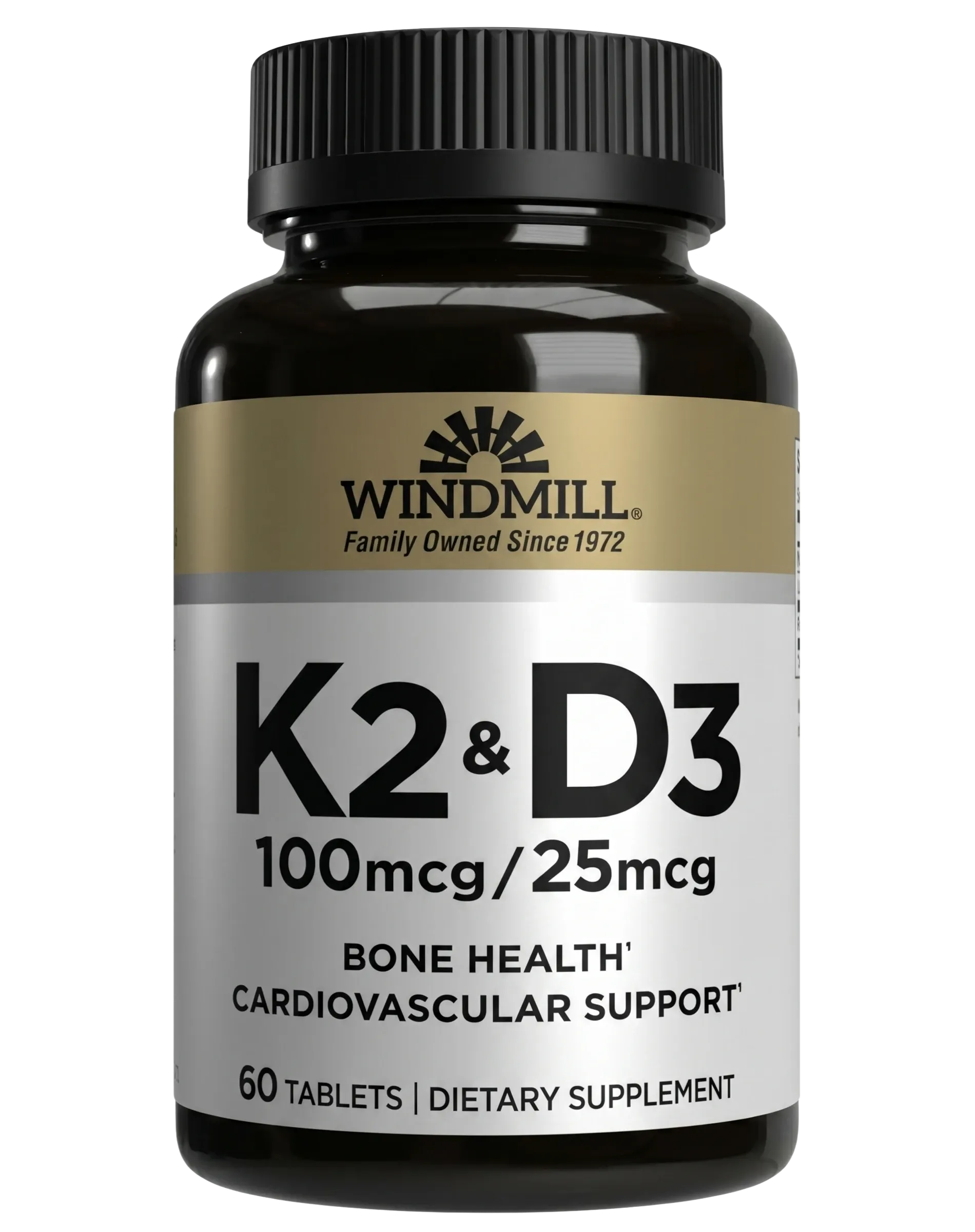
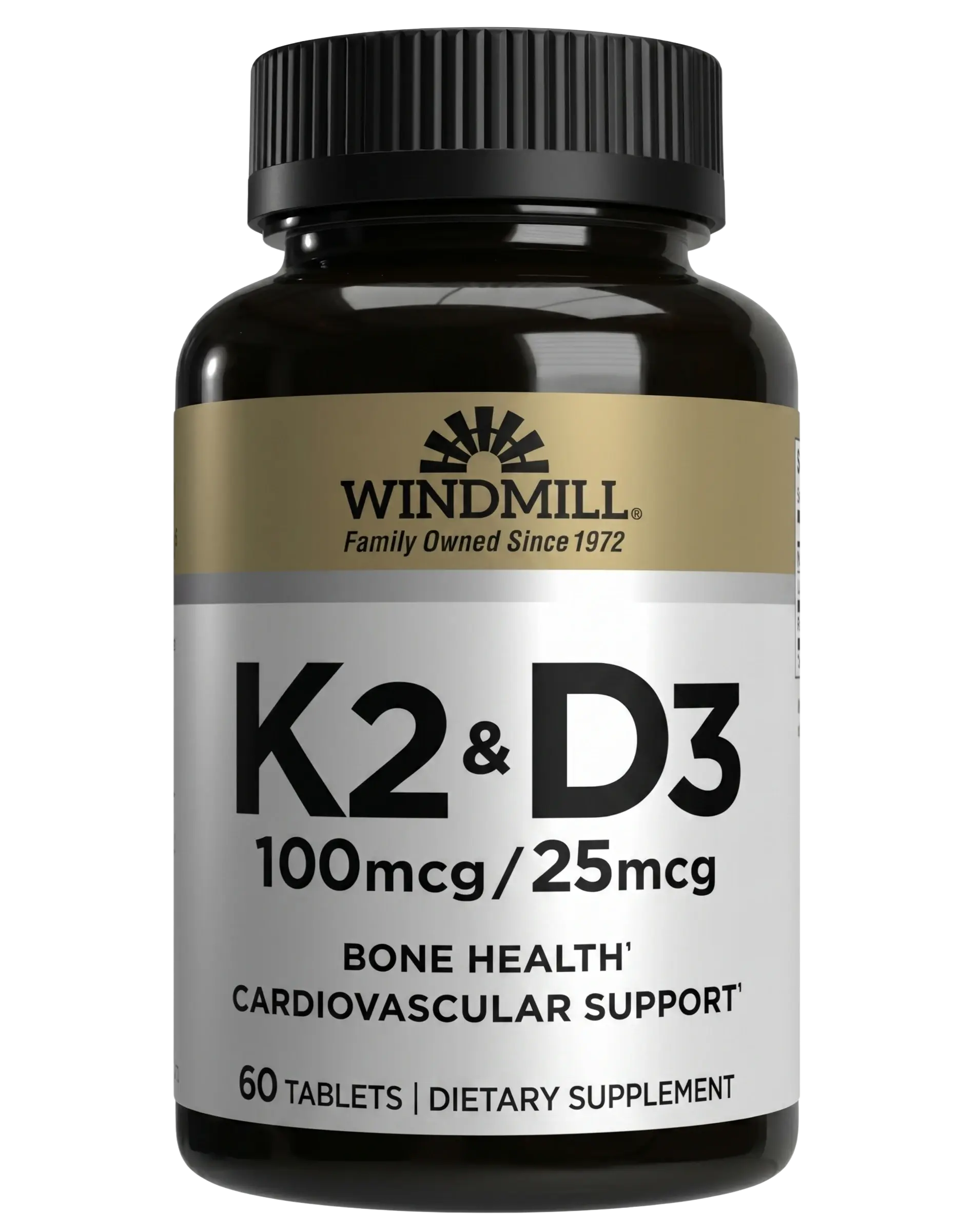
Windmill Vitamin K2 & D3 100mcg/25mcg Tablets 60ct
$9.99
Prioritize MK-7 if you want one form. Look for 90–200 mcg per serving. Anything below 90 mcg is likely underdosed based on the clinical literature.
Check the source. Quality MK-7 is typically derived from natto (fermented soy) or synthesized via fermentation. The label should specify "menaquinone-7" or "MK-7 from Bacillus subtilis natto."
Pair it with D3. Vitamin D3 dramatically increases calcium absorption. Without adequate K2, that extra calcium needs somewhere to go — and arteries are not the right answer. As covered in our complete guide to taking vitamin D and K2 together, the two nutrients work synergistically and are best taken at the same time.
Avoid unnecessary fillers. Stearates, titanium dioxide, and artificial dyes add nothing. GMP certification is a minimum quality signal — it tells you the manufacturer follows FDA good manufacturing practices for supplements.
Softgels over tablets for absorption. K2 is fat-soluble. A softgel with oil-based delivery (olive oil, MCT) improves absorption compared to a dry compressed tablet, particularly if you're taking it without a meal.
The Windmill Vitamin K2 & D3 100mcg/25mcg Tablets 60ct pairs MK-7 with D3 in a single tablet, covering both nutrients at a practical daily dose — a sensible choice if you want convenience without managing two separate supplements.
The Honest Verdict
MK-7 is the form with the most credible human evidence at realistic supplemental doses, and 100–200 mcg daily is where the research is strongest. MK-4 at low supplemental doses is not useless, but it's borrowing credibility from a very different (and very high-dose) clinical tradition. If a label doesn't specify MK-4 or MK-7, that's already a red flag worth taking seriously.
Frequently Asked Questions
Never run out.
Subscribe to any product and save 10% on every order. Pause or cancel anytime.
Subscribe & Save 10%Q: Can I get enough K2 from food alone?
A: Natto is the only food with truly high MK-7 content — a single tablespoon delivers over 900 mcg. Hard cheeses and egg yolks contain modest amounts of MK-4. For most Western diets, food alone rarely delivers the 90–200 mcg range shown to affect osteocalcin carboxylation in clinical trials.
Q: Is vitamin K2 safe to take with blood thinners like warfarin?
A: No — do not combine them without physician supervision. Vitamin K directly counteracts warfarin's mechanism. Even modest K2 supplementation can destabilize INR levels. This is one of the few supplement-drug interactions that is well-documented and clinically significant.
Q: Does it matter what time of day I take K2?
A: Take it with your fattiest meal of the day. K2 is fat-soluble, so co-ingestion with dietary fat meaningfully improves absorption. Time of day is otherwise less critical than consistency — daily dosing is what sustains the stable blood levels that MK-7's long half-life is designed to deliver.
Where to Find Quality Vitamin K2 Supplements
Moore Vitamins carries GMP-certified K2 options with same-day fulfillment and Subscribe & Save pricing for consistent daily use. The Windmill Vitamin K2 & D3 100mcg/25mcg Tablets 60ct combines 100 mcg of K2 with 25 mcg (1,000 IU) of D3 — pairing the two nutrients that work best together into a single daily tablet. It's a straightforward, no-guesswork option for anyone looking to cover both bases without juggling multiple bottles.
Never miss a dose.
Evidence-based wellness guides like this one, in your inbox. No hype, no spam — unsubscribe anytime.