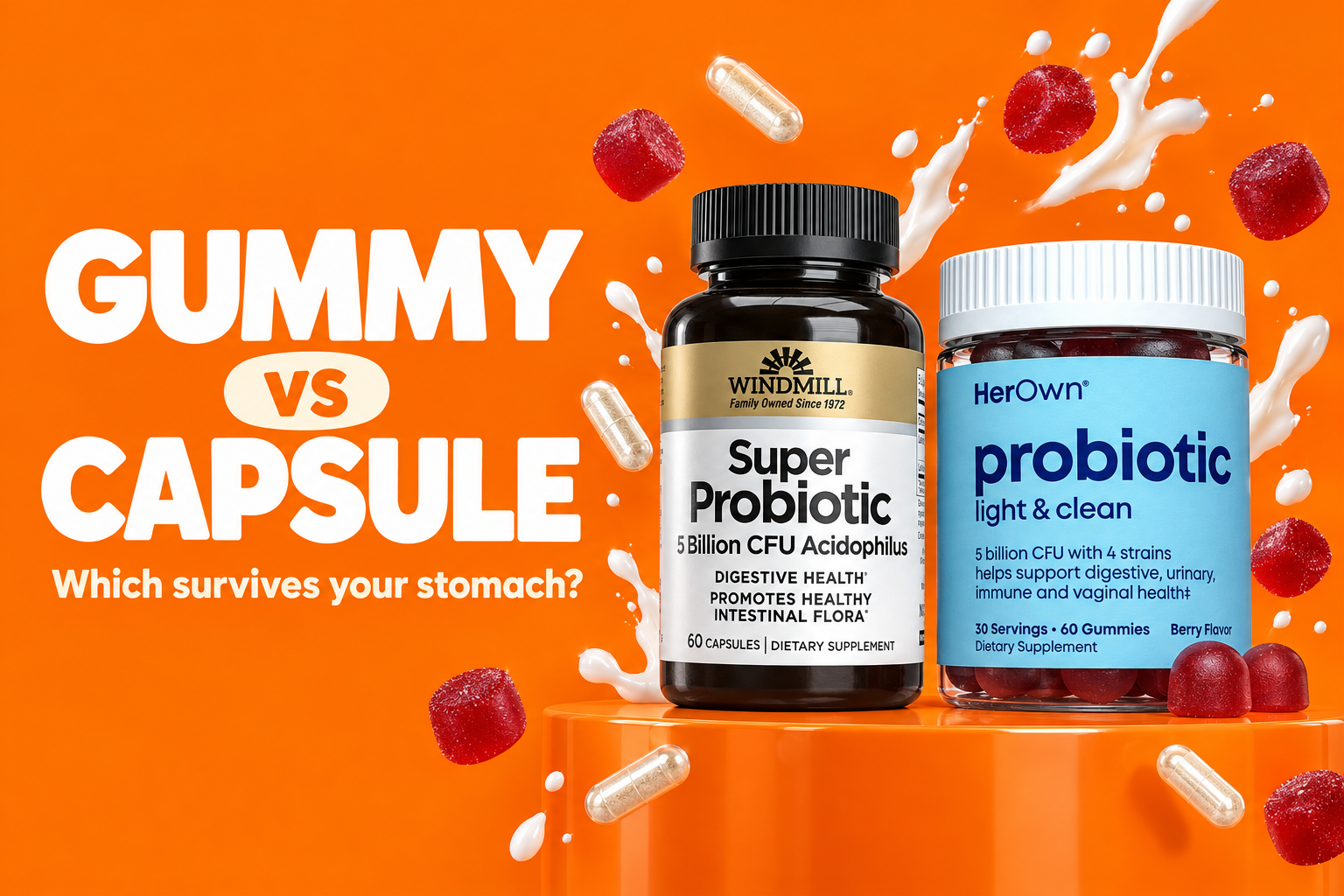
Probiotic Gummies vs Capsules: Which Survives Your Stomach?
Quick Answer: A probiotic only helps if enough of it reaches your gut alive, and stomach acid (around pH 1.5 to 3.5) kills a large share of most bacteria on the way. Capsules usually carry more cultures and more strains per serving. Gummies are made with heat, so the better ones use hardy, spore-forming strains such as Bacillus coagulans or Bacillus subtilis, which are built to survive both heat and acid. Neither format wins on its own. What decides it is three things on the label: the strain, the CFU count "at expiration" rather than "at manufacture", and the sugar. If you want the highest count and the widest mix of strains, choose a capsule. If you'll actually take a gummy every day and you won't take a capsule, a well-made gummy beats a bottle of capsules sitting in a drawer.
Do probiotic gummies work as well as capsules?
They can, but they're doing a different job.
A typical probiotic capsule holds 5 to 10 billion CFU (colony-forming units) across one or more Lactobacillus and Bifidobacterium strains. Those are the strains most studied for digestive comfort, but they're sensitive. Heat, moisture and acid all reduce how many arrive alive.
Gummies are cooked and set, which is hard on delicate bacteria. That's why many gummy makers switch to spore-forming Bacillus strains. A spore is a dormant, armoured form of the bacterium. It rides through the stomach and only wakes up in the intestine.
So the real question isn't gummy or capsule. It's whether this strain suits this format.
What actually survives your stomach
Three things decide how many live cultures make it through:
- The strain. Spore-formers like Bacillus coagulans and Bacillus subtilis tolerate acid far better than most Lactobacillus strains.
- When you take it. Research on probiotic survival suggests that taking it with a meal, or just before one, helps more bacteria get through than taking it on an empty stomach. Food raises stomach pH for a while.
- Storage. Heat and humidity kill cultures in the bottle before you ever open it. Keep probiotics somewhere cool and dry, not on a sunny windowsill or above the stove.
The NIH Office of Dietary Supplements probiotics fact sheet is a good, plain-language overview of which strains have been studied for what.
How to read a probiotic label
This is where most people get misled.
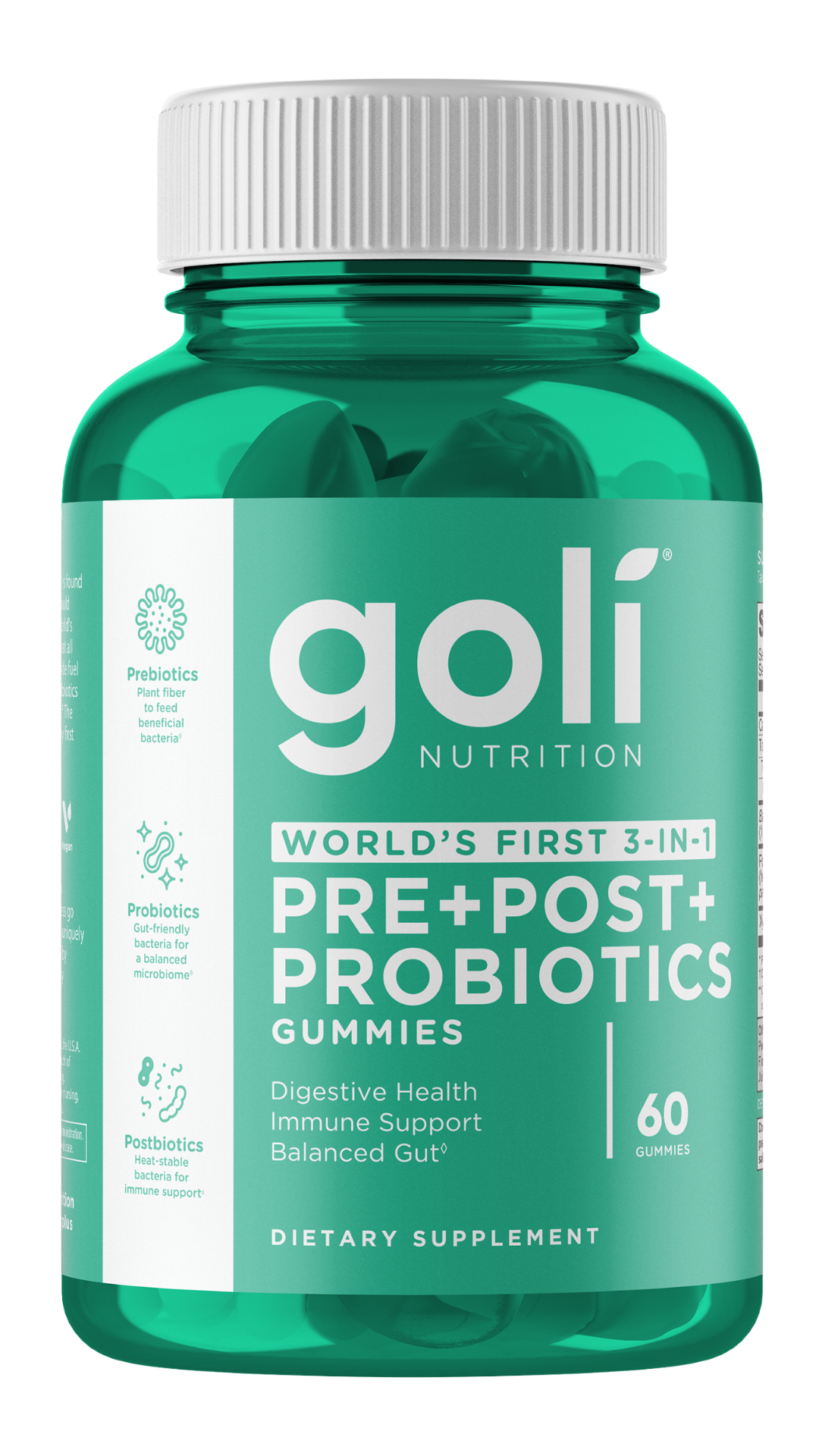
"At manufacture" vs "at expiration". A count "at time of manufacture" tells you how many cultures went in. A count "at expiration" tells you how many are guaranteed to still be alive on the last day. The second number is the honest one. Goli's Pre+Post+Probiotic gummies, for example, state 1 billion live cells of Bacillus subtilis DE111® at expiration.
Strain names, not just species. "Lactobacillus acidophilus" is a species. A full strain name has a code after it. Products that name their strains are easier to check against research.
Sugar. Gummies need something to hold their shape. Some use cane sugar and syrup; others use fibre. Goli's probiotic gummies carry 5 g of added sugar per 3-gummy serving. Her Own's probiotic gummies list 0 g added sugar and use 4.8 g of FOS (a prebiotic fibre from beets) instead.
Prebiotics. A prebiotic is fibre that feeds the good bacteria. It's a useful extra, but a large dose of fibre can cause gas for the first week or so. Start with a smaller serving if your stomach is sensitive.
Capsules vs gummies: a quick comparison
| Capsules | Gummies | |
|---|---|---|
| Typical CFU per serving | 5–10 billion | 1–5 billion |
| Typical strains | Lactobacillus, Bifidobacterium | Often Bacillus spore-formers |
| Number of strains | Often several | Usually one to five |
| Sugar | None | 0–5 g, depends on the brand |
| Easiest to keep taking | If you don't mind pills | If you hate swallowing pills |
Common mistakes
Choosing by CFU alone. Ten billion of a fragile strain that dies in the bottle isn't better than one billion of a hardy strain that arrives alive.

Related Product
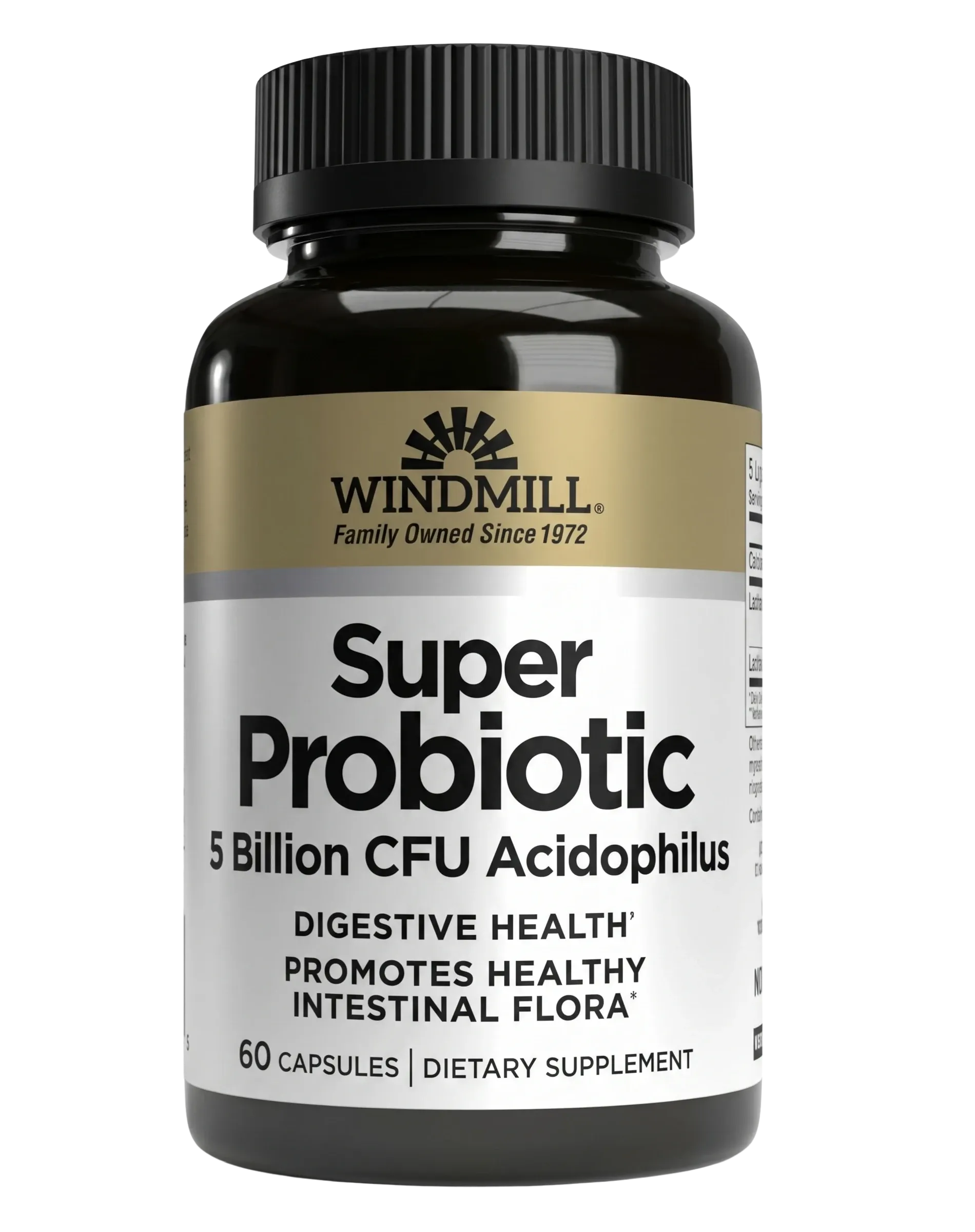
Windmill Super Probiotic 5 Billion CFU Capsules 60ct
$12.79
Taking it with hot coffee. Very hot drinks can damage live cultures. Take your probiotic with water or food, not a scalding mug.
Quitting after a week. As we cover in how long probiotics take to work, most people need several weeks of daily use before they can judge.
Switching every month. Pick one product, take it consistently for a month or two, then decide.
How to choose, in practice
- Hate swallowing pills? Choose a gummy that names a spore-forming strain and states its count at expiration.
- Want the most cultures for your money? Choose a capsule with a stated CFU and named strains.
- Watching sugar? Read the added-sugar line on the gummy, or go with a capsule.
- Take it with breakfast, every day, and store the bottle somewhere cool.
For more on how the format changes what you absorb across all vitamins, not just probiotics, see our gummy vitamins vs capsules comparison.
Frequently Asked Questions
Q: Are probiotic gummies a waste of money?
A: Not if they're well made. A gummy that uses a hardy, spore-forming strain and states its count at expiration can deliver live cultures. The ones to skip don't name their strains or only give a count at manufacture.

Subscribe & Save
Never run out.
Subscribe to any product and save 10% on every order. Pause or cancel anytime.
Subscribe & Save 10%Q: Should I take probiotics on an empty stomach?
A: Research on probiotic survival suggests taking them with a meal, or shortly before one, helps more bacteria survive stomach acid. Follow the label if it says otherwise.
Q: Can I take a probiotic gummy and a capsule together?
A: There's usually no need. Pick one and take it consistently. If you're managing a health condition or taking antibiotics, ask your doctor or pharmacist how to time a probiotic around them.
Q: Do probiotics need to be refrigerated?
A: Only if the label says so. Many shelf-stable probiotics, including most gummies, are made to be stored at room temperature. Keep them away from heat and humidity either way.
Find the Right Probiotic at Moore Vitamins
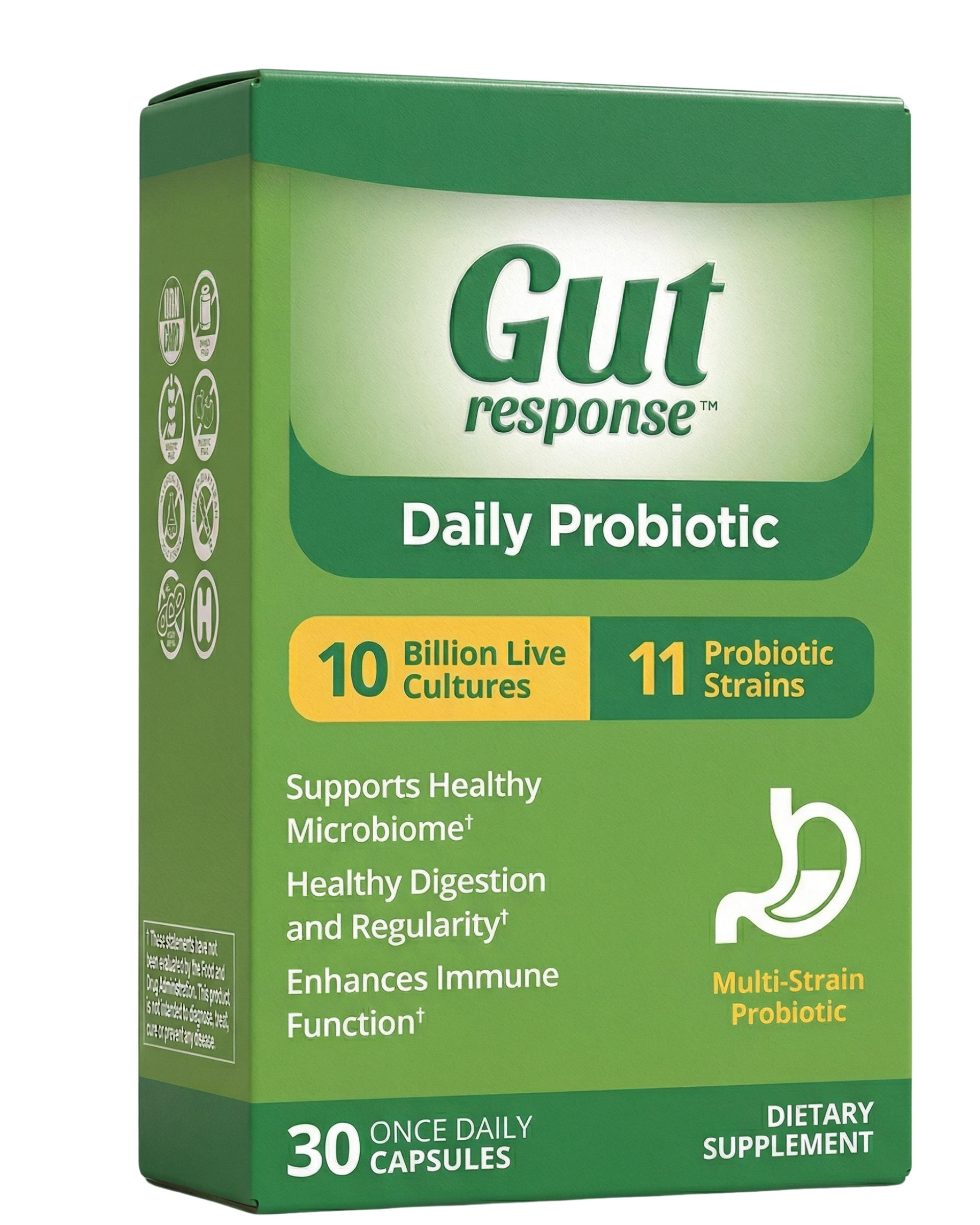
If you prefer a capsule, our house-brand Windmill Super Probiotic 5 Billion CFU Capsules deliver 5 billion CFU of Lactobacillus acidophilus plus lactase in one capsule a day. If you want more strains, Gut Response Daily Probiotic Capsules carry 10 billion CFU across eleven strains.
Prefer to chew? Her Own Probiotic Gummies give 5 billion CFU with 0 g added sugar, and Goli Pre+Post+Probiotic Gummies use the spore-forming Bacillus subtilis DE111®.
Through November 30, probiotics are 10% off. The discount applies itself in your cart, so there's no code to type. Every order ships fast, and Subscribe & Save keeps your supply coming. Want the bigger picture first? Start with Probiotics & Gut Health: Top Questions Answered.
You can also browse peer-reviewed research on probiotic survival in the stomach.
Never miss a dose.
Evidence-based wellness guides like this one, in your inbox. No hype, no spam — unsubscribe anytime.